From green bin to green gas: how York Region is turning household waste into renewable energy
Each year, the facility will process up to 200,000 tonnes of organic materials, including contributions from the York Region’s green bin program and convert it into 10 million Nm3 of renewable natural gas (RNG) annually, enough to supply the equivalent of 5,000 Canadian households. What was once destined for landfill will instead heat homes, fuel vehicles, and feed the region's gas grid.
A second life for carbon
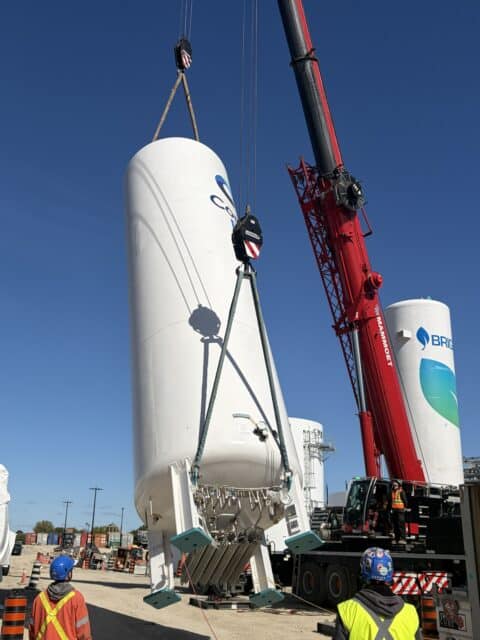
For us, the story does not end with gas. As biogas is upgraded to RNG, the CO2 naturally released in the process gets captured rather than emitted. With a 2,000 kg/hr CO2 liquefaction system, we’ll recover and convert this carbon into 10,000 tonnes of liquid bioCO2 per year, a product used across industries from food and beverage to greenhouse growing. Instead of adding a refrigerant to cool and liquefy the gas, we use the CO2 itself, keeping the process energy-efficient and free of additional chemical inputs.
Closing the loop for the region
The facility completes a local loop: household organic waste is processed on site, with residual material converted into certified biofertilizer for growers in the region, while the biogas is upgraded into RNG and bio-CO2. Beyond the environmental case, the project supports local jobs and gives Convertus Group full oversight of gas and CO2 quality in-house, through the integrated control, gas analysis, and instrumentation package we supply, without needing a third party.
That upgrade step runs through a biogas upgrading system we’ve rated at 2,500 Nm3/hr, where a three-stage membrane separates methane from CO2 with minimal losses, a detail that directly determines how much RNG the region gets out of every tonne of waste that comes in.
Curious what a similar setup could look like for your own site? Explore our biogas upgrading and CO2 liquefaction technology, or get in touch with our team to talk through the possibilities for your facility.